
As I've gotten older, there's been such a shift in how I and my friends…
13 Incredible Frank Lloyd Wright Places You Need to See in Person
No name is quite as famous in American design as that of Frank Lloyd Wright. During his 70-year career, he built over a thousand buildings and his mark on our country’s architectural history and influence over later architects cannot be understated. Both an innovator and dreamer, his approach to creation was so groundbreaking, we’re still talking about his philosophy of organic architecture (where our natural surroundings should be in harmony with humanity) to this day.
From intimate family homes to grand museums, here are some of the most incredible Frank Lloyd Wright places to visit today.
13 Stunning Frank Lloyd Wright Places to Visit

1. Frank Lloyd Wright Home & Studio in Oak Park, Illinois
If you want to see as many Frank Lloyd Wright buildings as possible in one place, then make sure to visit Oak Park, Illinois. This is where Wright and his wife, Catherine, settled between 1889 and 1911. During their 20+ year stay, he built a number of homes both in town and nearby Chicago, many of which you can still see today.
The first place, of course, is to visit the Frank Lloyd Wright Home & Studio where he lived and designed said buildings. What makes this home even more special is that it’s the very first time Wright ever had full artistic control, thus allowing him to fully experiment with his various philosophies and concepts. He truly covered all aspects of this house from the open interior layout right down to the furniture and lighting.
Fun Fact: Ernest Hemingway was born in Oak Park and lived here through high school. He was born in 1899. Do we think Wright and a young Hemingway ever crossed paths?
2. The Dana Thomas House in Springfield, IL
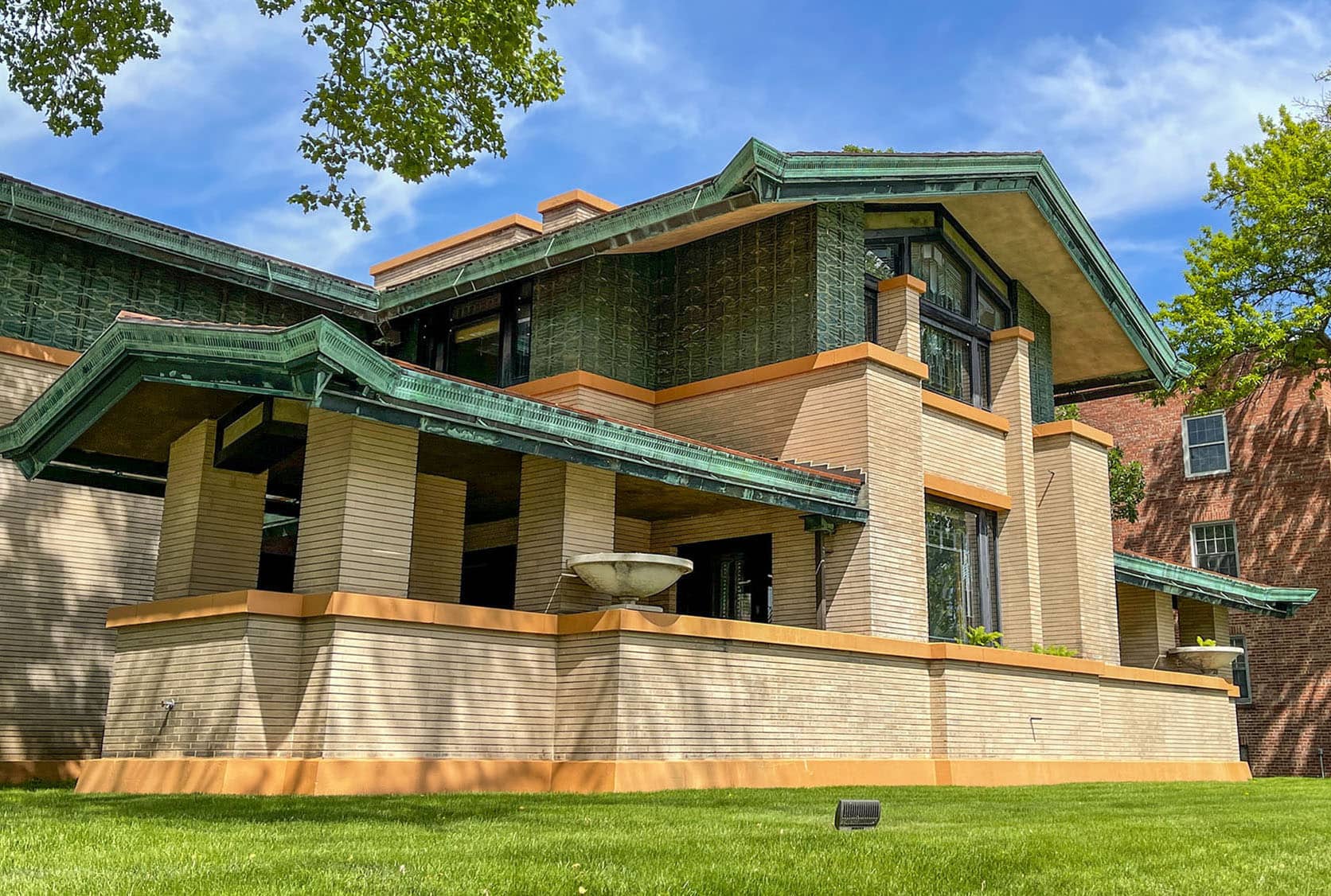
If you’re planning any sort of road trip along Illinois’s portion of Route 66, you’ll inevitably find yourself in Springfield. It’s home to a number of iconic landmarks like Lincoln’s Presidential Library and the Cozy Dog Drive In, but what some people miss is that it’s also home to one of Frank Lloyd Wright’s best preserved and most elaborate early prairie houses. He remodeled Dana’s family’s Italianate-style mansion between 1902 and 1904 for heiress, philanthropist, and women’s right activist Susan Lawrence Dana.
The “Thomas” part of the name comes from the second owners, Charles C. and Nanette Thomas, who owned the home until their deaths. It’s thanks to them that the house still maintains nearly all of the original designs and furnishings. Their estate even sold it to the state of Illinois for much less than its worth just to keep it intact.
Today you can visit the house, you just need to book tickets and reserve a spot.
See more of Springfield in our “Route 66 of Illinois” episode of Season 7’s “Places to Love.”

3. Fallingwater in Mill Run, PA
Located in the Laurel Highlands region of Pennsylvania, Fallingwater is often cited as Frank Lloyd Wright’s magnum opus and is, of course, a UNESCO World Heritage Site. It was commissioned by Edgar and Liliane Kaufmann (of Kaufmann Department Store) in 1935 to be a rural weekend retreat away from the city. It would stay in the family until the 1960s when their son entrusted the land to the Western Pennsylvania Conservancy to keep up its preservation.
Built partly over a waterfall on Bear Run, Fallingwater is one of the best examples of Wright’s organic architecture philosophy. You can see all sorts of ways he made sure the surroundings were incorporated throughout the home. From the lack of curtains to the way the furniture was custom built or the way the sounds of the waterfall can be heard through the house, it truly is a blend of humanity and nature.
Be sure to book a tour and if you can, plan your trip in the fall to really see Fallingwater in all its beauty surrounded by foliage.
4. Price Tower in Bartlesville, OK
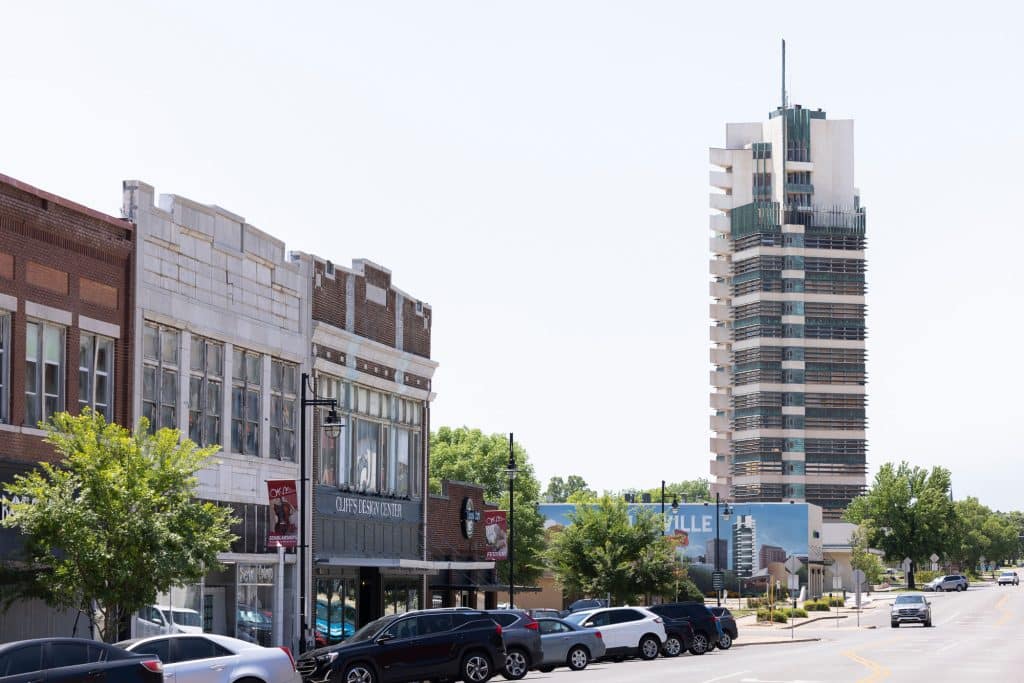
Wright only built one skyscraper in his career, and that 19-story building is in the small city of Bartlesville, Oklahoma. Back in the 1950s, the HC Price Company hired Wright to create a more modern building for their headquarters, and he subsequently used a design he once created for apartments in NYC. After four years, Price Tower was opened, clocking in at a whopping 221 feet.
Made of copper and concrete, it stands out in downtown Bartlesville. Wright designed the building to be like a tree with the first four elevator shafts as the “trunk” and the upper floors as the “branches.” The “leaves” are found in the tower’s copper panels and sun louvers. In fact, Wright called the tower “the tree that escaped the crowded forest.”
Recently, the tower’s existence has been in flux and it’s been closed to the public. However, it was just purchased by McFarlin Building LLC who plans to restore it to its former glory! And, of course, if you visit Bartlesville, you can’t miss it towering over dowtown.
5. First Unitarian Society of Madison, WI
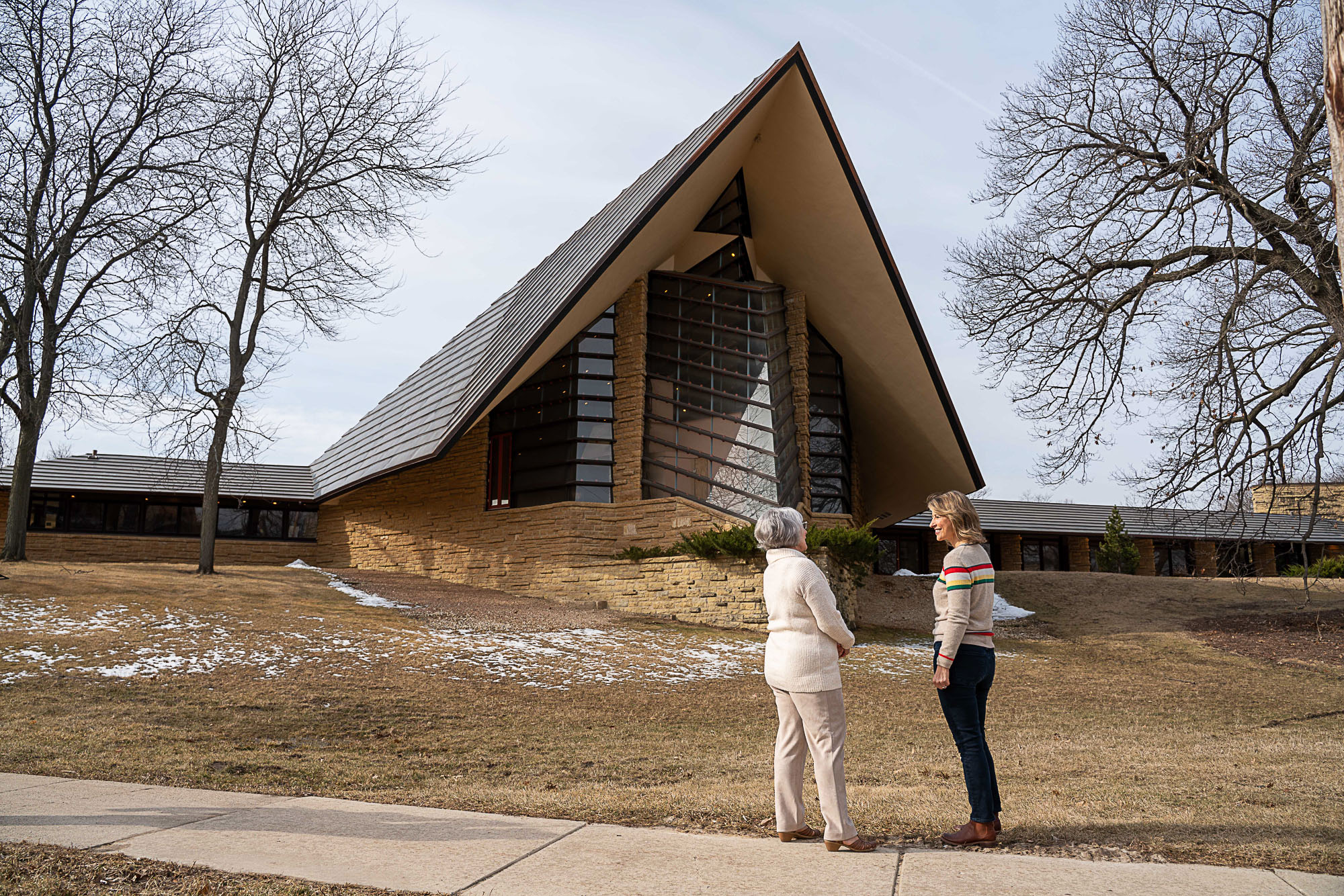
There’s a very good reason why Frank Lloyd Wright was chosen to design a new building for the First Unitarian Society of Madison, Wisconsin – his parents had been founders of the congregation all the way back in 1879. Continuing in his organic tradition, the meeting house was built with all natural materials and it looks as though it’s rising out of the ground. The triangular shape and low roofing are one of the world’s most unique examples for church architecture. This innovation perfectly matches the Unitarian’s own forward-thinking teachings.
You don’t have to be a practicing member to enjoy the building. There are public tours available most Sundays throughout the year and most weekdays April – October. Just check their website for a calendar and to book tickets.
See more in our “Madison” episode of Season 6’s “Places to Love.”

6. The Guggenheim in NYC, NY
The Guggenheim in New York City is easily one of the most magnificent museums in the world. Wright was originally commissioned to build this modern museum in 1943 for the Solomon R. Guggenheim Foundation’s Museum of Non-Objective Painting. His directives for this new building? According to the curator, Hilla von Rebay, they wanted a “temple of spirit, a monument!” For Wright, this was a chance to put his architectural philosophy to the test in an urban setting like Upper Manhattan.
The project would face a number of delays and wouldn’t actually open up until 1959 after Wright’s death, but today stands as an incredible example of modern design. Inside is a ramp that spirals up six levels continuously, and anyone can spot the white spiral exterior from blocks away.
In order to visit, just be sure to reserve timed tickets in advance. And for anyone who may be on a budget, just know the museum offers a pay what you wish every Saturday from 6:00 – 8:00 PM (minimum is $1, recommended is $10).
7. Grady Gammage Memorial Auditorium in Tempe, AZ
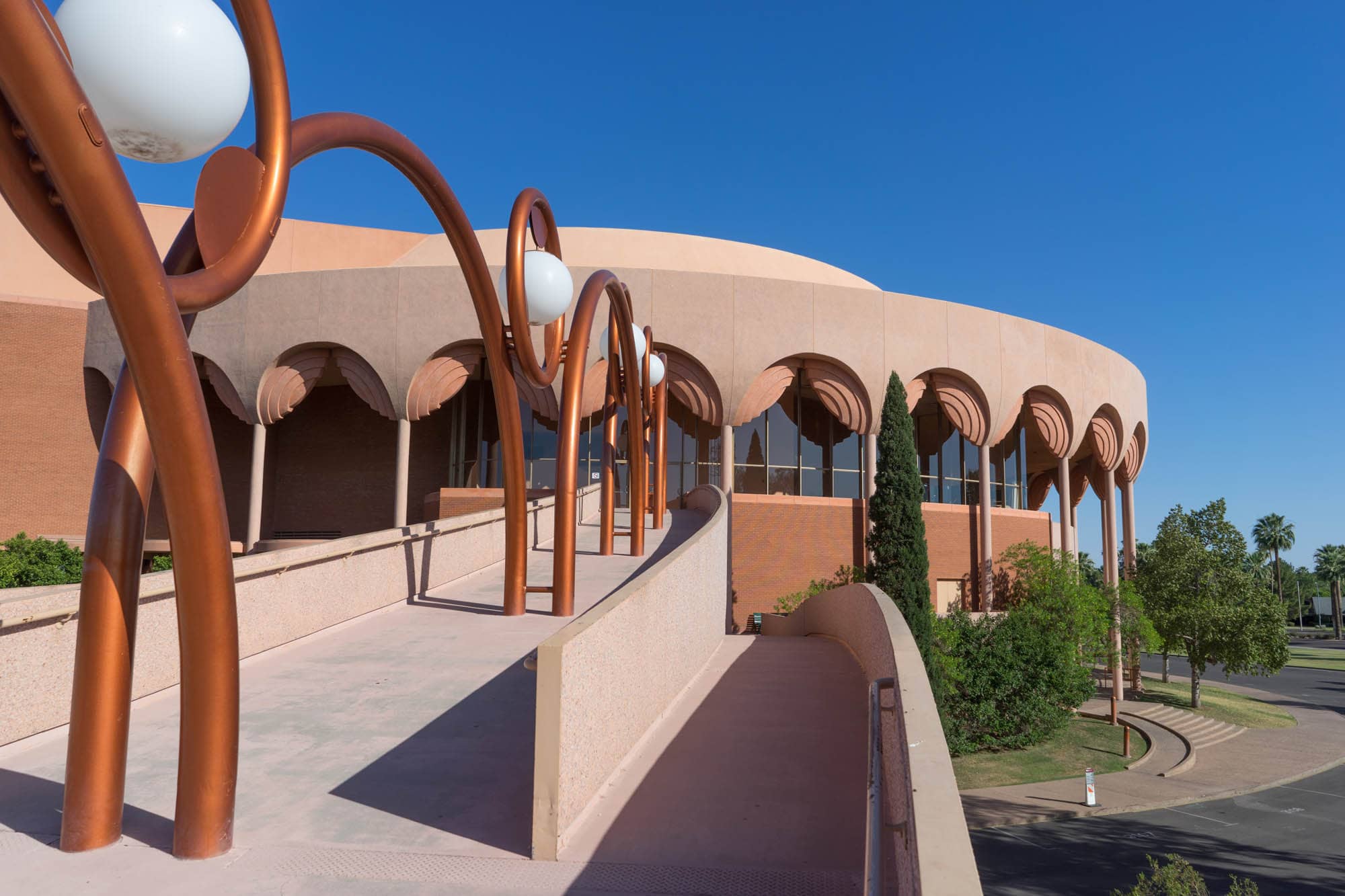
If you ask me, the Grady Gammage Memorial Auditorium (ASU Gammage) in Tempe, Arizona looks like it belongs in a Wes Anderson film! Belonging to Arizona State University, it was one of Wright’s last public commissions, coming in 1956, and would be built between 1962 and 1964. Wright was friends with ASU’s president at the time, Grady Gammage.
The design of the auditorium was actually based on a Usonian architectural design Wright had begun for an opera house in Baghdad commissioned by King Faisal II before the king’s assassination. You can easily spot its pinkish shell structure from afar, and its interior was designed to accommodate a large range of performances. Everything from presidential debates to Broadway musicals have found a home here.
While it doesn’t look like you can just tour the auditorium, you can, of course, see it from the outside and book tickets to a show. Just know – you can only bring a small clear bag or a tiny clutch no bigger than half a letter paper in with you!
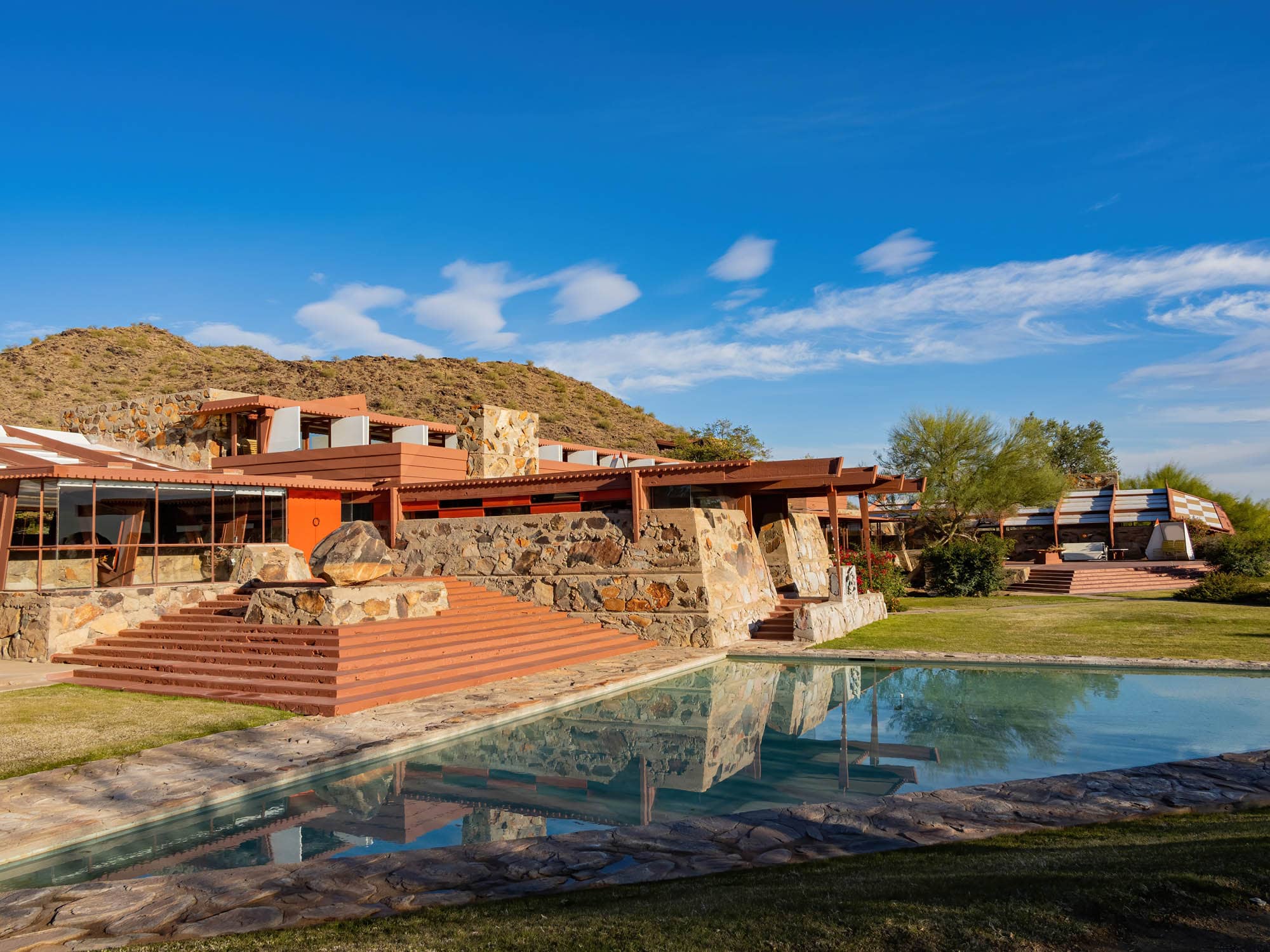
8. Taliesin West in Scottsdale, AZ
Not only is Taliesin West another of Wright’s buildings to land on the UNESCO World Heritage Site list, it’s also one of his most personal. After all, he lived, worked, and taught here each winter until his death. Nestled in the foothills of the McDowell Mountains, it was built by both Wright and his apprentices in 1937. He wanted to create an oasis that would reflect the great vastness of the desert. To do this, he built the walls with local desert rocks and would often look around him for materials instead of importing anything in.
What also makes Taliesin West so special is that this is also where Wright is buried. Although originally buried in Wisconsin, members of the Taliesin Fellowship cremated his body and interred it in a memorial garden on the property. To visit, you just need to book a tour.
See more in our “Phoenix, AZ” episode of Season 3’s “Places to Love.”
9. Sterling Kinney House in Amarillo, TX
There are only four Frank Lloyd Wright buildings in Texas, and one of them is in the Route 66 town of Amarillo! Until recently, the Usonian-style Sterling Kinney House was almost myth like in its existence. (There are no pictures on Google Maps, and it doesn’t even have its own listing on the main FLW site).
Commissioned by Dorthy Ann and Sterling Kinney in 1957, it was one of Wright’s last design projects before passing in 1959. The way the story goes, the Kinneys visited with Wright to convince him that the Texas Panhandle would be the perfect spot for his architecture!
To this day not much is known about the home for a few reasons. The first is that the home is somewhat secluded — hidden mainly by trees. Because Wright was on the decline when he took the project, he never actually wrote about the project. And to make things even more complicated, it shares a name with another FLW building in Lancaster, WI, and thus doesn’t come up easily in Google searches.
One of the most unique things about the house today is that its owned by Amarillo local, Robin Gilliland, who took great pains to buy and restore the house after Dorothy Ann passed. It’s one of the few FLW buildings still used as a private residence, and you can see some of the interior in this Brick & Elm article. If you’re driving through Amarillo, it’s worth driving over to see what you can from the road. And, hey, you never know — Gilliland often allows local groups use of the house for events, so ask around Amarillo and see if your trip coincides with one of them!

10. The Zimmerman & Kalil Houses in Manchester, NH
Of the few Frank Lloyd Wright houses you can visit in New England, two of them are right in Manchester, New Hampshire.
The Zimmerman House (above) was designed in response to “ultra-conservative” style most New England homes had back in the late forties, early fifties. The Zimmerman family wanted something that reflected their way of life, and Wright designed something in his classic Usonian style.
Newer to the list is the Kalil House, which was not open to the public until 2019. It’s only three blocks from the Zimmerman House, and the former owners, Dr. Zimmerman and Dr. Toufic Kalil, were actually friends and colleagues. Its style is different in that it’s a Usonian Automatic design, meaning Wright utilized concrete blocks to build the Kalil’s house.
To visit both, you must book a tour through the Currier Museum or Art, who now owns them. They have their own van that will take you from the museum to the neighborhoods, and after a brief introduction you’ll be able to explore the interiors on your own.
See more in our “New Hampshire Seacoast & More” episode of Season 7’s “Places to Love.”

11. Hollyhock House in Los Angeles, CA
Located in Barnsdall Art Park with views of the Hollywood Sign and Griffith Observatory, Hollyhock House was actually Wright’s very first commission in Los Angeles. He was hired by oil heiress Aline Barnsdall to build a theatrical complex on what was then known as Olive Hill. However with various complications and cost overruns over the next three years, Barnsdall eventually fired Wright when the complex was nearly complete. A few years after that, it was donated to the city of Los Angeles.
These days you can visit Hollyhock House on a tour and then enjoy southern California’s sunny weather in the park itself. Plenty of Angelinos come here for a bit of an escape within the city an to enjoy the surrounding views. Make sure you book tickets in advance!

12. Kalita Humphreys Theater in Dallas, TX
The only theater design Frank Lloyd Wright actually saw completed is in Dallas, Texas! Back in 1955, the Dallas Theater Center approached Wright about designing a theater for them. Since he was busy with other work, he told them he would only take on the project if he could use one of his previously unrealized designs. After they agreed, he used a design originally meant for the West Coast Theater and then Hartford, CT. The whole ethos of the design is to unify both actors and audience, so it was created with a circular stage surrounded by eleven rows of seats, making performances feel more intimate.
It’s another creation that was only completed after Wrights’ death in 1959. These days it’s part of the larger AT&T Performing Arts Center and still hosts performances. Check here to see what’s playing when you visit!
See more in our “Dallas, Texas” episode of Season 3’s “Places to Love.”

13. Taliesin in Spring Green, WI
Last and certainly not least is yet another UNESCO World Heritage Site, Taliesin, which was built on land that once belonged to his mother’s family. One of the things that makes Taliesin so unique is its history and the fact that it had to be rebuilt three times spanning 1911 to 1959. It thus grew as Wright’s architectural practices grew.
Taliesin I was designed very much in his Prairie School style. It nestled against a hill and was designed with local materials and with his trademark band of windows to let as much nature in as possible. Unfortunately, it burned down in a gruesome tragedy that left his mistress, her children, and many of the workers at his estate dead as well. Taliesin II was finished in 1915 and looked almost identical to its predecessor. It too was destroyed in a fire, though this one was likely caused by an electrical surge and everyone survived.
If Taliesins I and II were shrouded in controversy and tragedy, Taliesin III represented the love Wright’s students and clients had for him. More or less bankrupt, Wright had to give up the land after the bank foreclosed on it in 1927. Then, one of his clients helped create a company called Frank Lloyd Wright Inc, in which people could buy stock and essentially help raise funds for a new Taliesin. Former clients and students bought enough for them to buy the property back, and Wright would go on to build the Taliesin you can visit today.
There are plenty of different tours you can book to both learn more about Taliesin’s history and see not only the house itself but the surrounding property he would go on to buy while alive.
Frank Lloyd Wright’s legacy lives on to this day, and it’s been such an incredible experience visiting his many homes and creations through all my travels. He represents the beautiful blend of dream and design, and his organic architecture philosophy still feels fresh and groundbreaking over a century later. There are so many more places he’s built around the country; many of them once simple family homes. Any I need to add to my list and visit in the future?

Comments (37)
Leave a Reply
Related Posts

I have to add the Darwin D. Martin house in Buffalo, NY to your list. https://martinhouse.org/
It’s one of FLW’s most beautiful examples of prairie architecture and he was given artistic freedom to create a stunning showpiece.
If you make it to Buffalo to see the Darwin D. Martin house and their Summer house, which are beautiful – I would recommend as an added bonus to make your way to East Aurora NY to the The Roycroft Inn – 40 South Grove Street • East Aurora, NY 14052. This is where FLW would stay when he was in Buffalo overseeing the construction of the Martin’s houses.
The Roycroft Campus in East Aurora, New York, is the best-preserved and most complete complex of buildings remaining in the United States of the “guilds” that evolved as centers of craftsmanship and philosophy during the late 19th century. Founded by Elbert Hubbard in 1897, it is often considered the birthplace of the American Arts & Crafts Movement. The Campus, designated a National Historic Landmark in 1986, contains nine of the original 14 structures including the Inn, the Chapel, the Print Shop, the Furniture Shop, and the Copper Shop.
I went to Manchester, Vt last month. I saw two Frank Llyod Wright’s Houses. Currier Museum of Art owned both houses. You can visit the houses through a tour with Currier Museum of Art. They were excellent docents lead tours.
That is Manchester NH not VT.
Those houses, and the Currier Museum, are in Manchester, NH, not VT. (I have yet to visit them, and I live only about 20 miles away! One of these days…)
They are actually in Manchester, New Hampshire.
And both on the same street!
Florida Southern College in Lakeland, Florida.
It’s a Frank Lloyd Wright destination.
Hollyhock House in LA. A visit there and then a visit to the Gamble House in Pasadena for a quick study in contrast of style. Both are amazing!
There is the Martin House in Buffalo, NY, and Graycliff-Darwin and Isabelle Martin’s summer home, just south of Buffalo. There are also newly constructed works of a boathouse, mausoleum and gas station using Wright’s original drawings or blueprints.
If you are a Wright fan, there are homes in many states. Michigan has the Meyer May House, Wisconsin has the FLW Trail, which includes Wingspan, and the suburbs of Chicago have many more besides the Home and Studio.
You missed Florida Southern College in Lakeland, FL. Largest single site collection.
I was surprised that you didn’t mention the house Frank Lloyd Wright designed in Buffalo, New York. Fallingwater is beautiful, but be sure to take a sweater as I almost froze when visiting there in June.
Please consider taking a tour of the Laurent House in Rockford Illinois. It is a Usonian home designed for a paraplegic man, Kenneth Laurent and his wife Phyllis. It is the only home built for someone handicapped and in a wheelchair. Besides being an incredible home it has a wonderful story to tell.
While in Rockford, home to the Rockford Peaches and the band Cheap Trick you can visit one of the country’s top Japanese gardens. Rockford also has a resurgent downtown area, many wonderful local restaurants and is home to the Rockford Icehogs who is the farm team of the Chicago Blackhawks.
There is a wonderful history of the once “screw capital of the world” and I think you will love the riverfront and the people.
You should check out the Darwin Martin House in Buffalo, NY. It’s beautiful, with a long pergola to the conservatory. There is also the Barton House and a gardener’s cottage on the same property. (The gardener’s cottage is a beautiful house on its own!) Over by the water is a boathouse Wright also designed. We have some great architecture in Buffalo!
Add the Darwin Martin House in Buffalo New York. Has been recently restored. The Martin summer home, also designed and built by Wright is just 30 minutes south in Derby New York on the southern shore of Lake Erie.
Buffalo has a significant connection to Frank Lloyd Wright. Unfortunately, some of the buildings he built downtown are now gone. There is at least one other Wright house in Buffalo, now a private residence.
Folks in the South may not realize the jewel to be had in Central Florida. The collection of FLW buildings at Florida Southern College is the largest in the world! Check it out!
https://www.gogulfstates.com/2023/06/see-the-greatest-concentration-of-frank-lloyd-wrights-architecture-in-the-world/
Add to your list the Marin County Civic Center located in San Rafael California, just 30 minutes north of San Francisco! They have docent tours too.
If you go to Fallingwater, be sure to also see Kentuck Knob. It’s Wright’s hidden gem only 7 miles away! Privately owned with an extensive collection of art both in the house and on the grounds.
My daughter was 9 when we visited falling water. The home finished in 1939 at a cost of $140,000. The experience was breathtaking. The details are magnificent
Interestingly the ceiling throughout the home was minimal clearance as Mr. Kaufman was not a tall man and did not want tall ceilings. If you visit…the surrounding area is so beautiful. The yakahany river rafting is fun. I’m sure I misspelled that
Taliesin, Wisconsin
Amazing!
On a work trip, we realized we’d be near the Rosenbaum house in Florence Alabama. It was unexpected, sitting right in the middle of an average looking subdivision. It was very cool.
Samantha,
In addition to those places you mentioned, there are other sites that collectively form an UNESCO World Heritage site representing “The 20th Century Architecture of Frank Lloyd Wright”.
Along with Fallingwater, the Guggenheim Museum, Taliesin and Taliesin West, there is the following:
1. Unity Temple in Oak Park, IL (within walking distance from Wright’s Home and Studio)
2. Frederick C. Robie House in Chicago (on the campus of the University of Chicago)
3. Katherine Herbert Jacob’s Usonian House in Madison, Wisc.
4. Aline Barnsdall House “Hollyhock” in L.A., Calif.
Both Unity Temple and Robie are open for tours on a limited schedule by The Frank Lloyd Wright Trust, the same organization that operates tours thru his Oak Park, IL home and studio.
Here are two places in Kansas that both happen to be in Wichita. I love FLW! I can’t wait to visit all of his buildings!!!
https://www.flsouthern.edu/frank-lloyd-wright-home/history
Crystal Bridges Museum in Bentonville, AR has the Bachman-Wilson House and there is the Harvey P. Sutton House in McCook, NE.
Wherever we travel we make sure to hit any Frank Lloyd Wright sites along the way. I highly recommend Kentuck Knob, a short drive from Fallingwater. I think that is my favorite site – a cozy home with a sculpture garden on the grounds as well.
On a road trip during Covid we drove through Iowa (as one does) and stopped in Mason City to see the hotel designed by Frank, still in operation. The hotel workers are used to people showing up to wander around the hotel looking at the details. There is a statue of Frank just outside in a park as well – Frank’s mother was from Iowa, we learned, which is why many of his houses are there. We took a tour of the Stockman house in Mason City. Love Frank!
In the Houston area we have the William Thaxton House in Bunker Hill Village. It is one of only 3 FLW houses in Texas. It is privately-owned and not open to the public.
Marin county civic center
The Weltzheimer/Johnson home in Oberlin OH. Open the first Sun if the month this summer. Call for tickets and times. Have not been there but want to go just found out it was there Have been to the Wollcot home in Springfield Oh.
I’ve been to four spots: the original Taliesin in Wisconsin, the gas station in Cloquet, MN, Cedar Rock overlooking the Cedar River in Quasqueton, IA, and Southern Florida College in Lakeland, FL.
Here’s one I’m sure not many people know about. The Rosanbaum house in Florence Alabama. It is now a museum.
The R. W. Lindholm gas station in Cloquet, MN. It is the only gas station built by Wright.
in Herford, Colorado are three buildings Wright designed when he was just a draftsman – so he didn’t get credit – but you can’t miss them.
There’s a neat FLW home in Kirkwood, MO (near St. Louis) in Ebsworth Park called the Kraus House. Guided tours are available year-round and can be booked online at EbsworthPark.org
There is another gem in Racine, Wisconsin (about a 90-minute drive north of Chicago). There are several buildings on the Johnson Wax Headquarters campus designed & built by Wright and they are fantastic! Tours are available. Highly recommend.
There is a golf course on Maui that used a FLW design for the clubhouse. It is beautiful.
There is the gorgeous Westcott House in Springfield, OH. It was built by FLW in 1908 for Burton & Orpha Westcott. In the 1940’s, there was a housing shortage, and one of the subsequent owners had the home cut up into apartments. The house went through many owners and it eventually, tragically fell into horrendous disrepair, and was nearly forgotten. Fortunately, the Frank Lloyd Wright Building Conservancy got involved and helped the Westcott House Foundation acquire and restore the home to it’s former glory in between 2001 and 2005. It now is open to the public as a museum. It’s really quite beautiful!